Frequently Asked Questions
This page answers some of our most frequently asked questions. If you don't find an answer to your particular question below, contact us on our Contact Us page, write us a letter (address it to: O.K. Corral, P.O. Box 367, Tombstone, AZ 85638), give us a call (our number is (520) 457-3456), or email us at info@ok-corral.com.
Visiting the O.K. Corral
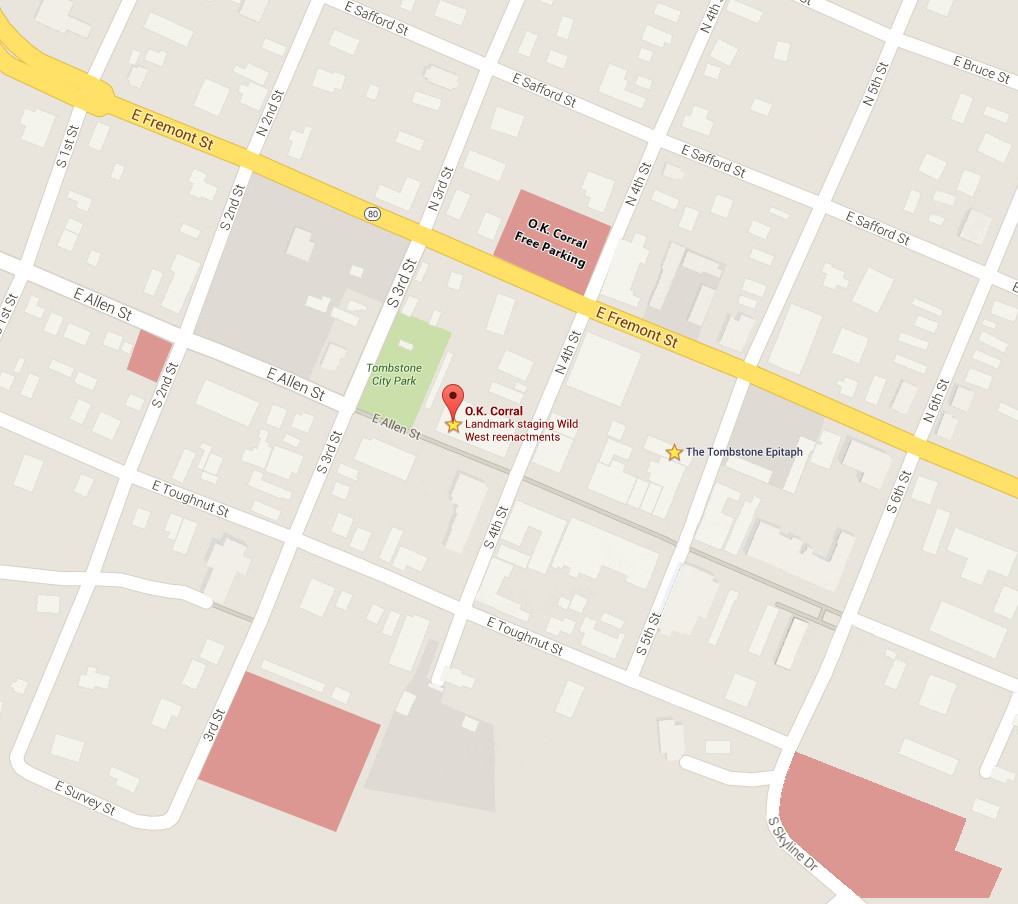
Free parking is available for O.K. Corral visitors in the nearby O.K. Corral Parking Lot behind the Corral on Fremont Street (Highway 80) between 3rd and 4th Streets. Additional free parking can be found on Toughnut Street by 3rd Street and by 6th Street. Cars are not allowed on Allen Street.
You can buy your tickets online – or tickets may be purchased at the O.K. Corral in person on the day of the performance. We recommend buying tickets at least 1-2 hours before the show since we often sell out.
We welcome group tours at the O.K. Corral. Groups of 21 or more should contact us in advance with how many people will be in your group, when you plan to arrive, and what you would like to see. At your request, we will try to provide a private tour guide. Please email info@ok-corral.com for information.
Visiting Tombstone
Tombstone is a historic Old West town in Cochise County, Arizona, founded in 1879 by Ed Schieffelin in what was then Pima County, Arizona Territory.
From Phoenix: Tombstone is approximately 180 miles (3 hours). From Phoenix, take I-10 south to Tucson and follow the directions below.
From Tucson: Tombstone is approximately 65 miles (1 hour and 15 minutes) southeast of Tucson. Take I-10 south to Benson, then take Highway 80 about 25 miles to Tombstone.
From Bisbee: Tombstone is approximately 25 miles north. Take Highway 80 north to Tombstone.
From Sierra Vista: Tombstone is approximately 20 miles (25 minutes) east of Sierra Vista. Take East Charleston Road east to Tombstone.
In addition to visiting the O.K. Corral® Historic Complex, Tombstone's Historama, and The Tombstone Epitaph Museum, many other Tombstone attractions are just a short walk down historic Allen Street. Most historic sites are open daily:
- Tombstone Courthouse State Historic Park
- Rose Tree Museum, with the world's largest rose bush
- Bird Cage Theatre
- Boothill Graveyard, where the Cowboys killed in the Gunfight at the O.K. Corral are buried
You can tour the town on a stagecoach or trolley, eat a buffalo burger, drink a sarsaparilla or taste local wines, buy genuine Indian jewelry or a custom saddle, purchase 1880s clothing, go horseback riding, shop for antiques, visit one of Tombstone's underground silver mines, and have your photo taken in an 1880s costume. There are a number of saloons, restaurants, and places to stay in Tombstone. Plan to spend a day to see everything. Nearby you can visit ghost towns, Fort Huachuaca, Bisbee, and the world famous Kartchner Caverns in Benson. Monthly, many Tombstone businesses are open late for First Friday activities. For more information, see Explore Cochise County, Land of Legends, the City of Tombstone Visitors Center, and the Tombstone Chamber of Commerce.
Tombstone has events going on almost every weekend. Check the event calendars at the City of Tombstone Visitors Center and the Tombstone Chamber of Commerce.
Fun Facts about the O.K. Corral
The phrase "O.K." – used to name Tombstone's historic O.K. Corral – had its origins in the Pennsylvania Dutch country of New York State in the mid-1800s. Today the term "O.K." appears in many languages and has become one of the most used phrases in the world. It is even used in computer programs to indicate agreement. Not bad for an idiomatic expression that is over 200 years old and almost disappeared from use.
Originally spelled with periods, this term outlived most similar abbreviations of the era owing to its use in President Martin Van Buren's 1839 campaign for reelection. During the Presidential campaign, candidate Martin Van Buren was supported by a political club in his hometown of Old Kinderhook, originally called the "Oll Korrect" club. The name was later changed to "Old Kinderhook" and was later shortened to "O.K." Van Buren was an O.K. Club member, and his supporters used the term as a general descriptive term for their candidate who they saw as "above average" or "outstanding." The abbreviation proved eminently suitable for political slogans and campaign pins, although Van Buren lost the election.
During the 1830s, it became fashionable in Boston newspapers to reduce a phrase to initials and supply an explanation in parentheses. Sometimes the abbreviations were deliberately misspelled to add to the humor. In March 1839, newspapers opposing Martin Van Buren's election used "O.K." as an abbreviation for "all correct," the joke being that neither the O nor the K was correct. Here is how one unhappy opposition newspaper of the time described Van Buren's O.K. campaign pins:
"frightful letters …… significant of the birth-place of Martin Van Buren, Old Kinderhook, as also the rallying word of the Democracy of the late election, "all correct" …. Those who wear them should bear in mind that it will require their most strenuous exertions …… to make all things O.K."
The term "O.K." then seems to have largely disappeared from use until some time after the Civil War. Eventually it came back into general use and was chosen by John Montgomery to describe his "O.K. Corral, Livery and Feed Stable," which he founded in Tombstone in February 1879.
How should "O.K." be written? John Montgomery always used "O.K." – with periods between the letters – on his Corral's 1880s signs. Today, however, there are many versions: two capital letters without periods, two capital letters with periods, o-k-a-y, or two small letters with periods. There is also the question about what part of speech "O.K." represents: a noun, a verb, an interjection, a complete sentence? In fact, the term "O.K." goes beyond the boundaries of any single grammatical category to encompass a huge range of expressions.
No. The "O.K. Corral, Livery and Feed Stable" was founded in Tombstone in February 1879 by partners “Honest John” Montgomery and Edward Monroe Benson (in 1882, Benson sold his interest to Montgomery). At the time of the gunfight on October 26, 1881, the O.K. Corral was one of seven liveries and corrals in Tombstone.
In the 1880s, many Tombstone residents did not own a horse or carriage. Instead they rented horses along with buggies and carriages from livery stables like the O.K. Corral. The O.K. Corral was completely destroyed in the Tombstone fire of May 25, 1882, together with much of the town's western business district. The Corral was rebuilt by Montgomery and was run by him until his death in 1917.
For much of the early 20th century, after the disappearance of the horse and buggy, the Corral housed an automobile repair shop. In the late 1950s a fledgling tourist operation in the Corral failed, and the property was facing bankruptcy. The Harold Love family purchased the O.K. Corral and surrounding properties in 1963 and undertook extensive historical restoration of the property, which remain ongoing.